
What Is a Video Workflow?
A video workflow is a set of conscious choices made before you press the record button.
These choices decide:
How the video will be shot
How it will be processed
How much flexibility you will have later
How efficiently the story can be delivered
In simple terms, video workflow is not something you fix in post-production. It is a decision-making process that starts before choosing the camera, before finalising specifications, and before locking the gear.
Every workflow is a balance between story needs, technical capability, time, and practicality.
The Choices That Define Video Quality
When people talk about video quality, they often focus on specifications. But quality is not just about resolution, bit depth, or codecs. Quality is defined by how well the video serves its purpose.
Before deciding how to shoot, a creator must answer a few practical questions.
Creative and Practical Considerations
What is your crew size?
How important is this project commercially?
Where will the final video be watched? (Mobile, TV, cinema screen, online platforms)
How much time do you have for delivery?
Is there a future need for re-editing or repurposing the footage?
These questions directly influence what level of flexibility is required.
Technical Considerations
Once the intent is clear, technical choices follow:
Will you shoot LOG?
Will you shoot 10-bit or 12-bit formats?
Will you shoot RAW internally or externally?
Post‑Production Intent
Another critical layer of decision-making is what happens after the shoot:
Will you colour correct the footage?
Will you change the look of the video after the shoot?
All of these together define the real quality of a video—not the spec sheet alone.
What Constitutes a Simplified Workflow
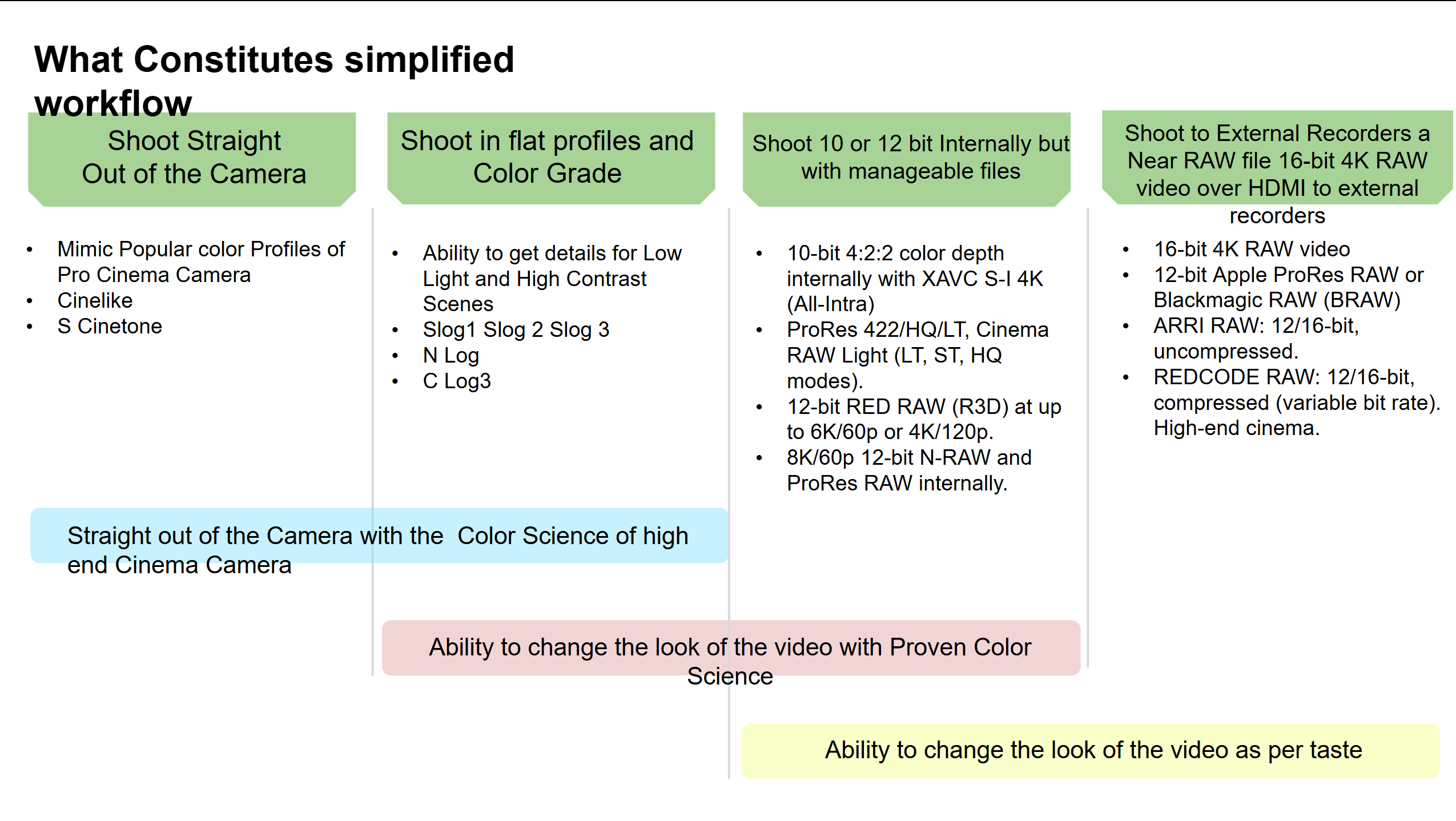
At a simplified level, modern video workflows can be grouped into three broad approaches. Each approach offers a different balance between speed, flexibility, and control.
Workflow Overview
1. Straight Out of the Camera
This approach focuses on speed and consistency. The camera processes the image internally using proven colour science inspired by high-end cinema cameras.
2. Flat Profiles with Colour Grading
This approach provides greater flexibility. The footage captures more detail in challenging lighting conditions and allows the look to be shaped during post-production.
3. RAW and Near‑RAW Workflows
This approach prioritises maximum data capture. It offers the highest level of creative control but demands more storage, processing power, and time.
As we move from left to right, the ability to change the look of the video increases—along with file sizes and workflow complexity.
Understanding the Technology in Simple Terms
Technology exists to support storytelling—not to complicate it. Understanding a few core concepts helps creators choose the right workflow without getting lost in jargon.
What Is Bit Depth?
Bit depth defines how many tonal values are available to describe colour and brightness. Higher bit depth means smoother transitions, better colour accuracy, and more flexibility in grading.
What Are Picture Profiles?
Picture profiles are pre‑defined image recipes created by camera manufacturers. They combine colour science, gamma curves, and image processing into predictable results.
They exist to help creators maintain consistency while offering different levels of flexibility.
What Are Gamma Curves?
Gamma curves describe how brightness transitions from black to white. They control contrast, tonal smoothness, and how much usable detail exists in shadows and highlights.
LOG is one specific type of gamma curve designed to preserve information in challenging lighting conditions.
What Is a Codec?
A codec defines how video data is compressed and stored. Since cameras cannot store unlimited data, codecs balance quality, file size, and processing efficiency.
What Is LOG Shooting?
LOG shooting redistributes brightness values to preserve midtone and shadow detail. It is especially useful in high‑contrast scenes where human vision is more sensitive to subtle tonal differences.
How Cameras See the World
A camera is fundamentally a data‑capturing device. It records light hitting the sensor and converts it into measurable digital information.
Unlike humans, a camera does not understand context, emotion, or story. It only records values.
Different manufacturers apply different mathematical models—known as colour science—to interpret this data. This is why footage from different brands looks different, even under identical lighting.
Human Vision vs Camera Capture
The human eye and a camera perceive brightness very differently.
When twice the amount of light hits a camera sensor, the recorded signal doubles.
Humans, however, perceive that increase as only a small change in brightness.
We are far more sensitive to changes in darker tones than in bright highlights. This difference is the reason gamma curves, LOG profiles, and dynamic range management exist.
The goal of all video technology is simple: to make camera‑captured data feel natural to human perception.
Sampling, Compression, and Practical Limits
Most video data is sampled and compressed. This is necessary to:
Keep file sizes manageable
Make workflows economically viable
Allow real‑world editing and storage
Manufacturers choose different compression strategies based on intended use cases, balancing quality with practicality.
How Modern Cameras Serve All Types of Creators
Modern cameras are designed to support a wide range of storytellers:
Vloggers
Cinema all‑rounders
Professional hybrids
Hybrid enthusiasts
They combine proven colour science with flexible recording options, allowing creators to prioritise detail where it matters most—whether in low‑light scenes or high‑contrast environments.
Some workflows offer manageable files with near‑RAW flexibility, while others deliver full RAW data similar to high‑end cinema systems.
The Single Most Important Element After Story
After the story itself, correct exposure is the most important technical factor.
Modern cameras provide advanced monitoring tools that help creators judge exposure accurately at the time of shooting. Getting exposure right ensures the footage remains flexible, usable, and aligned with the intended narrative.
A good workflow does not chase specifications—it protects the story.