1984 – 1994
Apple’s first-generation Mac computers used Motorola’s 68000 series processors. It offered stable performance but lacked long-term scalability.
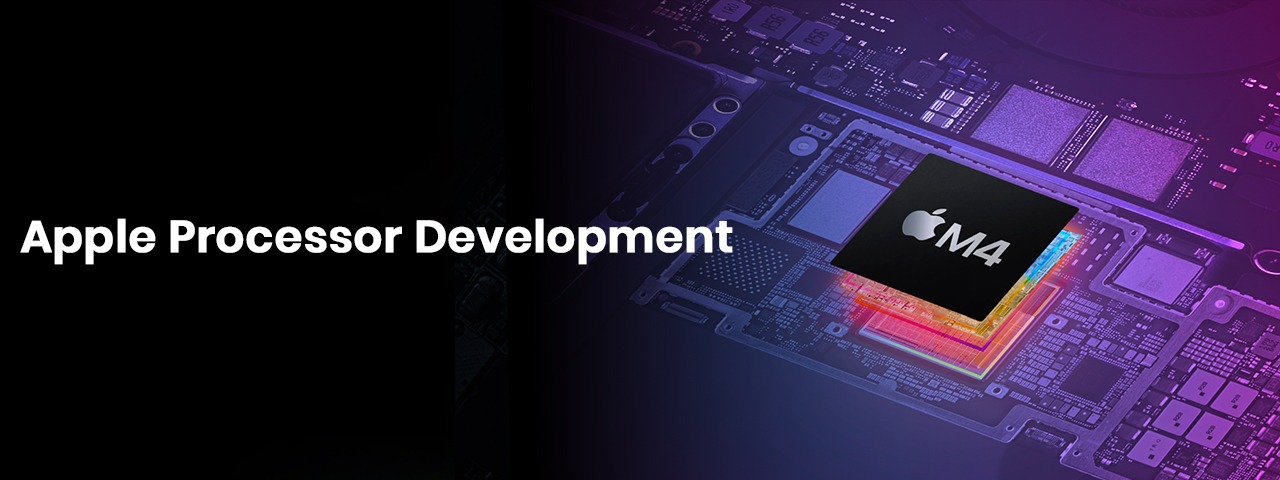
Apple’s journey in processor development is driven by a single vision — to build hardware and software that adapt seamlessly to each other.
Where most companies design processors and then adjust software around them, Apple does the opposite — it builds an operating system flexible enough to adjust to any hardware.
Apple’s first-generation Mac computers used Motorola’s 68000 series processors. It offered stable performance but lacked long-term scalability.
Apple switched to PowerPC for improved performance and efficiency. However, it eventually struggled with power consumption and heat issues.
The move to Intel allowed Macs to achieve high single-thread peak performance. But real-world responsiveness in thinner laptops was often limited due to thermal throttling and power management constraints.
A revolutionary shift — Apple designed its own ARM-based System on a Chip (SoC) that integrates CPU, GPU, Neural Engine, I/O controllers, and unified memory — all in one package. This integration enables blazing-fast communication between components and improved overall efficiency.
ARM processors are designed around efficiency and scalability.
Unlike Intel’s high-power chips, ARM cores consume less energy and generate less heat while maintaining strong performance.
Apple leveraged this by designing custom ARM-based SoCs — branded as Apple Silicon — optimized specifically for macOS.
ARM’s architecture allowed Apple to create processors that are:
Low cost
Low power consumption
Low heat generation
Highly integrated, enabling faster internal communication
Essentially, smaller transistors that produce less heat — leading to better efficiency with every new generation.
Apple’s SoC approach is a game changer:
Unified Memory Architecture (UMA): CPU and GPU share the same memory, reducing data transfer delays.
Faster Communication: Components are physically closer, reducing the distance signals need to travel.
Better Power Management: Integration allows Apple to optimize energy distribution across the system.
Downside: Since everything is on a single chip, RAM can’t be upgraded later — what you buy is what you keep.
Each generation of Apple Silicon pushes the limits of semiconductor manufacturing:
| Chip | Fabrication Process | Transistors (approx.) | Notable Highlights |
|---|---|---|---|
| M1 (2020) | 5nm | 16 billion | Apple’s first in-house chip for Mac. Efficient, cool, and powerful. |
| M2 (2022) | 5nm | 20 billion | Enhanced performance and better memory bandwidth. |
| M3 (2023) | 3nm | 25 billion | Improved energy efficiency; introduced multiple memory tiers (8GB, 16GB, 24GB). |
| M4 (2024) | 3nm | 28 billion | Highest transistor count yet, further refining performance-per-watt. |
Smaller transistors = less heat, more performance, and better battery life — that’s the continuous cycle of improvement.
Each Apple Silicon chip includes a Neural Engine, a dedicated section of the chip designed solely for Artificial Intelligence and Machine Learning tasks.
This engine now powers Apple’s AI ecosystem, rebranded as “Apple Intelligence.”
Its dedicated design allows faster and more efficient processing of AI workloads without stressing the CPU or GPU.
For Apple, the “ideal” processor must achieve:
This blend of hardware-software synergy is why Apple’s processors consistently outperform competitors in real-world usage, not just benchmarks.
Apple doesn’t just build chips — it builds ecosystems where hardware and software evolve together
Adding {{itemName}} to cart
Added {{itemName}} to cart